Fraying and Mending 1
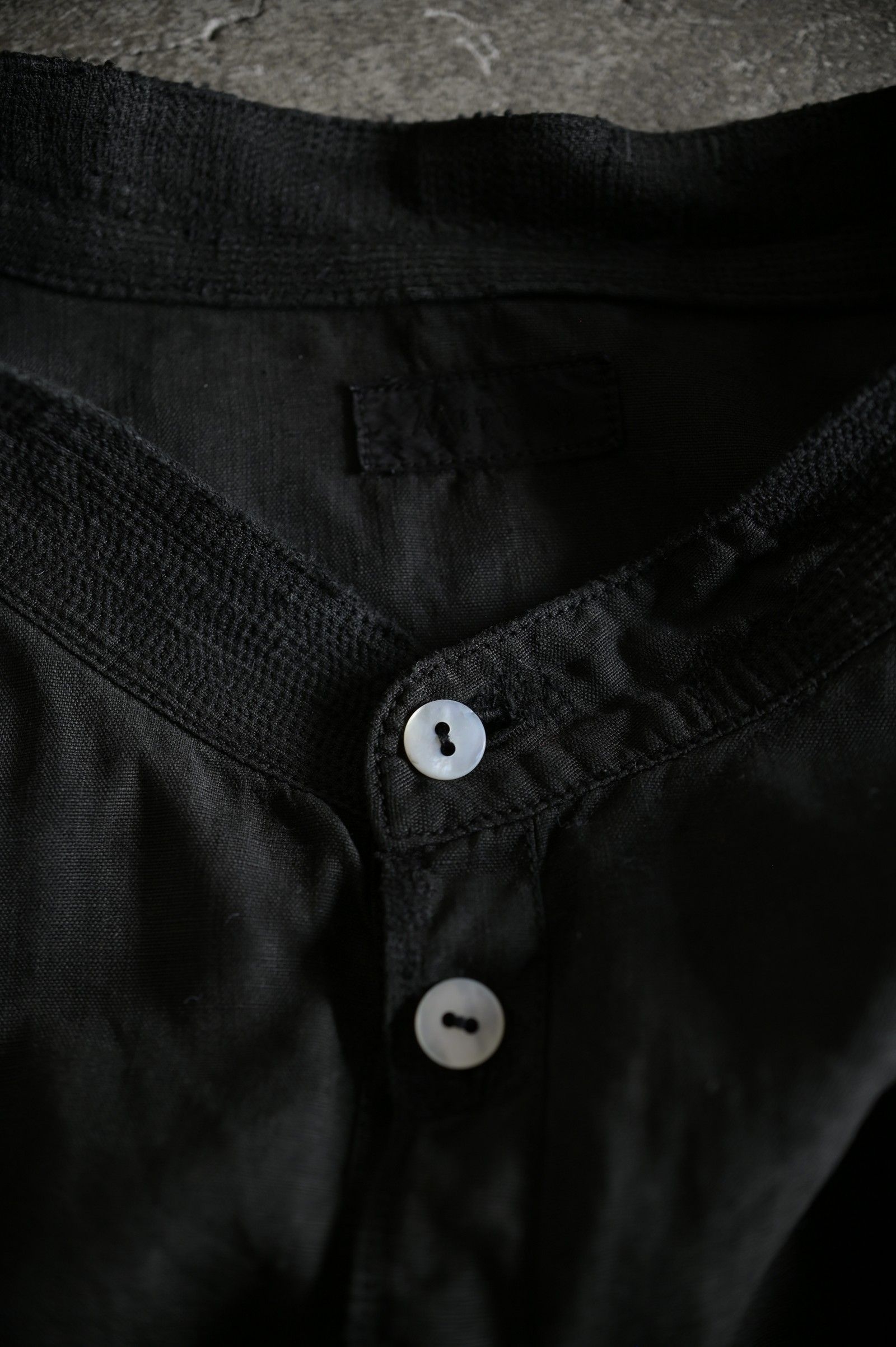
At MITTAN, we have never regarded wear or the marks of repair as something that lessens the value of clothing. What matters to us is that clothes are worn for a long time, mended again and again along the way. This is an excerpt from “Fraying and Mending: Accumulated Time and the Slow Growth of Value”, a conversation between Kazuto Kobayashi of OUTBOUND and MITTAN’s director, Takeshi Mitani, held on 20 September 2026 as part of “The Workshop Archive”, an open atelier at our workshop in Kyoto.
OUTBOUND, run by Kazuto Kobayashi, is a shop in Kichijoji, Tokyo, centred on handmade things, where tools and things that are not tools are presented side by side. It has carried MITTAN continuously since our very first season, spring/summer 2014. For the open atelier, OUTBOUND held a pop-up exhibition at MITTAN KYOTO, on the second floor of the same building. The goods travelled in wooden crates, surplus from the Swedish army, which were then stacked in the Kyoto shop and used as they were for display.
Kobayashi: Something I have been thinking about for a long time is whether the role of an object is really limited to its practical function. Clothing has many functions: protecting us from the cold, covering the body, showing status. But beyond those, I think there are invisible roles that differ from person to person. A garment can lift your mood when you put it on, or calm you down. It isn’t only clothing. Food can taste better eaten from a particular bowl. That has nothing to do with the bowl’s durability or how much it holds, the things you can measure in numbers. It is a value without a name, yet everyone recognises it in their own way. I decided to call it “effect”. Within a single object there are qualities that give it function and qualities that give it effect. That is how I see things.
Kobayashi: Clothes today are basically made on the assumption of repeat production, making a set number of pieces at the same quality. To achieve that, you have to pursue uniformity. But I sometimes wonder whether we feel a kind of suffocation when everything around us is uniform.
Mitani: When we make something new, we also think about wanting to make things that are like tools. We are a maker that produces in some volume, so at the point when we first propose something new, I see it as something whose role as a tool is strong.
Kobayashi: Objects take on meaning once people are involved with them. A T-shirt carries the sign of “clothing” and has a social role. A kitchen knife is a tool for cutting; a reusable bag is a tool for carrying things. If you say a T-shirt is something that covers the body and absorbs sweat, I doubt anyone would argue. That is because we all share the meaning given to each of these tools. Put the other way round, meaning is value that can be shared with others. It is because we share meaning that we can have a conversation like this one. Meaning is extremely important, but lately I have been thinking that it has become a little too dominant. I call the pressure to demand meaning “meaning pressure”, and precisely because that pressure has grown so high, I think people should, from time to time, escape from meaning.
Text: MITTAN