Clothing and the Desert
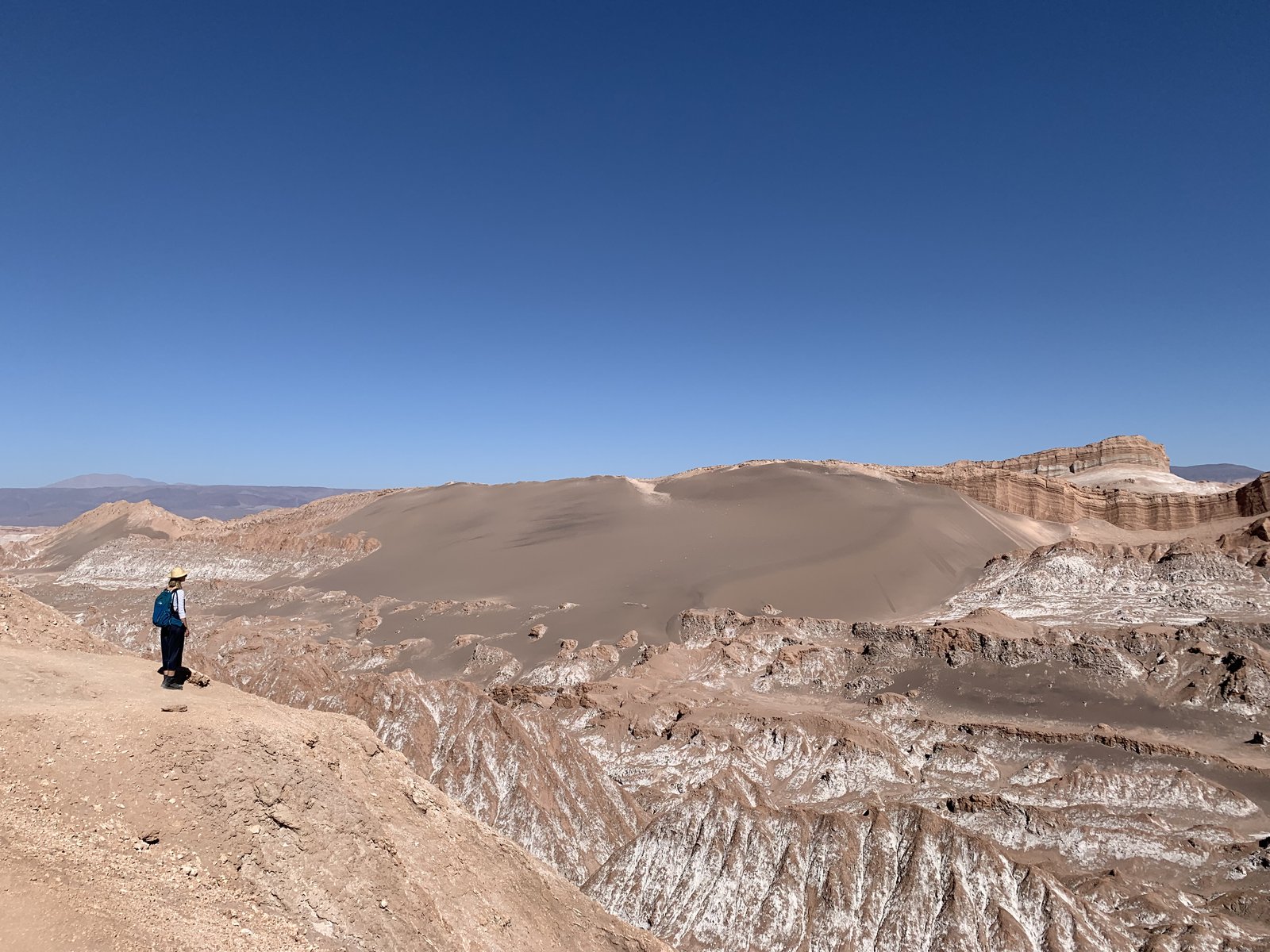
At MITTAN we have always hoped that by sharing as much as we can about the background of our products, people can build a good relationship with what they wear. Here we look at where clothing goes once it is no longer wanted, through the experience of the writer Yoshiko Nagai in the Atacama Desert of Chile. While she was there, driving across the vast desert, something that did not belong in the landscape appeared beyond a dune, and the image stayed with her. Only after returning home, when she came across reports of the enormous quantities of discarded clothing left in the Atacama, did she realise that what she had seen was clothes. Why is clothing abandoned in the middle of a desert in Chile?
When clothes are let go without ever passing through re-dyeing or repair, this making without an exit leads to disposal on a vast scale. Global fibre production reached a record of around 132 million tonnes in 2024, while clothing-to-clothing recycling, in which what we take off is reborn as something new, is said to account for less than 1% worldwide. So where does the other 99% go?
Chile is a country of dynamic climates and landforms. Stretching 4,300 kilometres from north to south, it holds contrasting environments within a single country: desert in the north, along the borders with Peru and Bolivia, and the cold of Patagonia and its glaciers in the south. In the north, the Atacama Desert opens out like a landscape from the earth’s earliest days. The deeply undulating valley known as the Valle de la Luna, the Valley of the Moon, was formed when the strata of an ancient inland salt lake were lifted by more than ten million years of tectonic movement in the Andes, and it is known for the mysterious sight of rock salt shining white at the surface. The indigenous people who have lived here since long before the region became part of the Inca Empire hold the knowledge needed to live alongside a nature so severe that survival is not easy. Limited groundwater is kept for fields and plants; snowmelt from the Andes is shared carefully within the community; life is lived together with llamas and other animals; and the stars are read precisely so that no one loses their way in the vast desert. They carry forward a culture handed down through generations, living with respect for an overwhelming natural world.
After the colonial period, as the industrial revolution advanced in Europe, mining developed in the Atacama from the middle of the nineteenth century and the desert became a source of raw materials for industry worldwide. In recent years lithium, essential to the batteries in our phones and electric cars, has been extracted from the salt flats of the Atacama. These salt flats have brought water to the indigenous people since ancient times and have been held as a spiritual foundation; they are also home to bacteria that, through photosynthesis, produce the oxygen on which life on earth depends. Debate over lithium extraction continues between local communities, led by the indigenous people, and international companies, and beneath it lies the fact that the resources of this region support urban life in countries far away.
At the same time, this vast desert takes in what people in distant countries no longer want. Mounds of clothing scattered across the folds of the desert, out of keeping with everything around them. However you look at it, this is not a landscape made by nature. The dumping of unwanted clothing gathered from around the world has become a serious problem in the Atacama. Chile is the largest importer of second-hand clothing in Latin America, taking in roughly 120,000 tonnes a year, mainly from Europe, North America and Asia. Much of it enters through the duty-free zone of Iquique, a city in the north. Around 59,000 tonnes reach the country each year, and at least 39,000 tonnes of what goes unsold are dumped illegally, burned in the open, or simply left in the Atacama. Many of these garments are synthetic fibres made from petroleum, said to take at least 200 years to break down. What kind of life does a garment pass through, from plant, animal or man-made fibre into clothing, into someone’s hands and then out of them, before it arrives in the desert?
Measures against disposal on this scale are now being introduced step by step. In June 2025 Chile added textiles to the priority products covered by its extended producer responsibility (REP/EPR) law, which requires manufacturers and importers to register and trace their products and to bear the cost of disposal. The EPR fund built on it supports not only companies working towards material recycling but also tailors and small businesses that repair garments so they can be worn again, with the aim of creating new local employment.
High in altitude and extremely dry, the Atacama has air so clear that it is also known for astronomical observation. With no cities nearby, the darkness at night is exceptionally deep, and an overwhelming number of stars can be seen with the naked eye. The sight of discarded clothing lying in the dust, never becoming part of the land, is said to be visible even in satellite images. Clothes made of materials that do not return to the soil do not disappear; they will alter this landscape for centuries to come.
Clothes that someone once wore, left behind in a place where human life itself is difficult, is a sight that rarely reaches the eyes of people in countries at the centre of mass consumption. And yet clothing treated as though it had never existed, lying in this vast desert, can be seen from space. That sight will likely remain long after human beings have vanished from the earth.
(References and sources)
・The Guardian
・National Geographic
・Al Jazeera (figures and environmental impact, 2021)
・UNEP (United Nations Environment Programme, an overview of fashion waste)
・EHN (Chile’s EPR law and producer responsibility)
・Textile Exchange, “Materials Market Report 2025” (fibre production and recycling rates)