Fraying and Mending 2
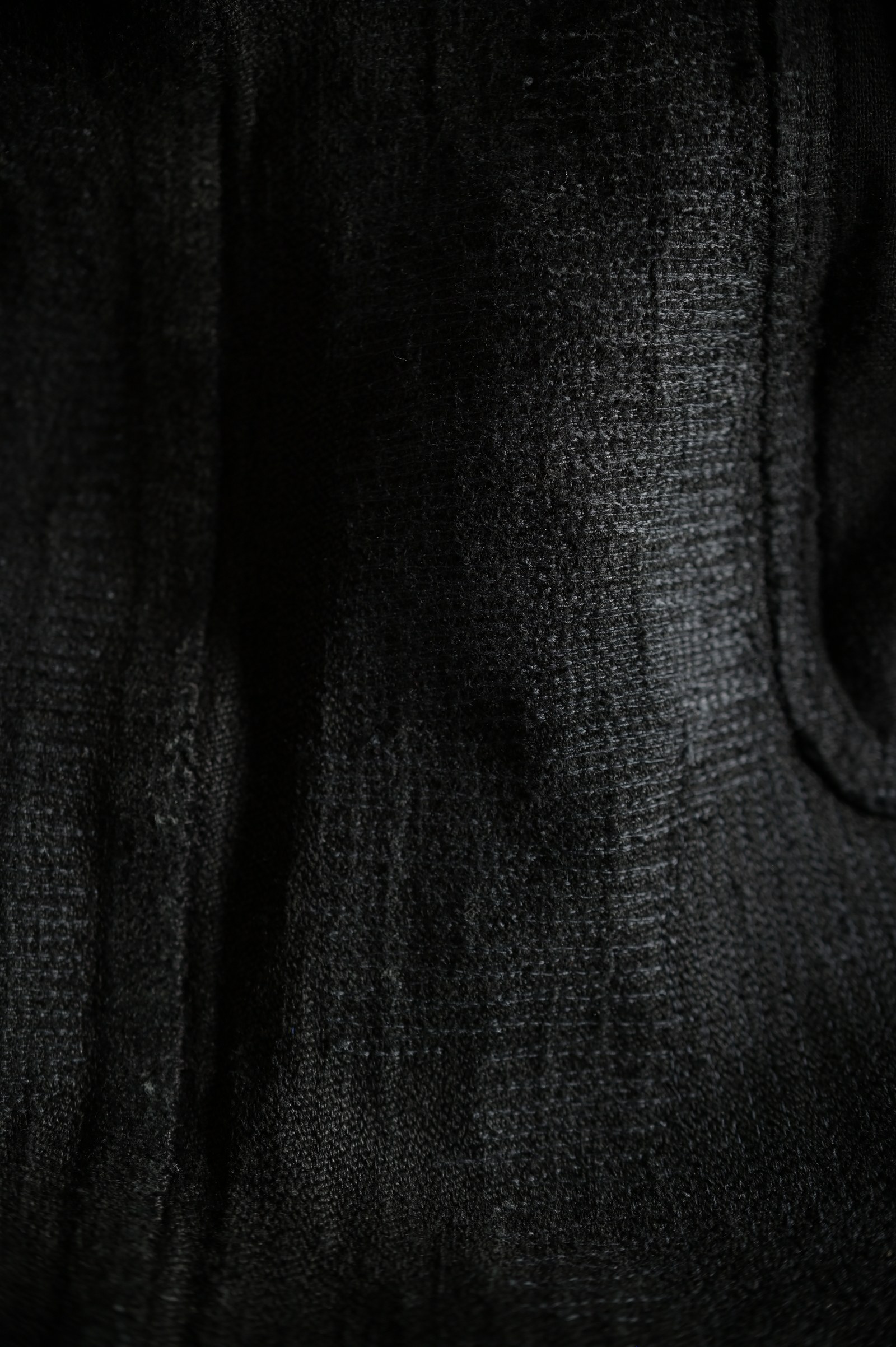
This is the second part of our conversation with Kazuto Kobayashi, owner of OUTBOUND in Kichijoji, Tokyo. In part one, he spoke about how objects have a role he calls “effect”, alongside the functions that can be measured in numbers, and about why, now that the pressure to demand meaning has grown so high, people should from time to time escape from meaning.
Mitani: When we met to prepare, we talked about things you can throw away and things you can’t. Could you tell us about that again?
Kobayashi: There was a MITTAN cut-and-sew top with a raw-edged neckline. It has been discontinued now, but I wore it all the time. While it was still wearable as clothing, the thread on the sleeve began to come loose, and a bundle of thread about 15 cm long formed. It wasn’t special thread, just ordinary, industrially made thread, but somehow I couldn’t throw it away. That bundle of thread is no longer part of a T-shirt. But it is also completely different from the state it was in when it was shipped as thread. It has become something nameless that belongs nowhere. In other words, it has been cut off from meaning. I think that is what felt so refreshing about it.
A reusable bag is the same. When it is new, it stirs no feeling at all, but as you use it, there are times when you look closely and find yourself gazing at it, lost in thought. An ordinary cotton bag, nothing special about it. I think that is because its original uniformity has been undone by washing and rubbing. Its function may be wearing away, but if you hang it on the wall and look at it, the bag’s worn face becomes a window you can drift off through.
There is no personal story behind that thread. It is simply no longer in the state it was in when it was shipped. Whatever that time was, you have to say that a time of its own has soaked into it. Meaning may disappear as things fray, but in exactly that measure, I think something irreplaceable builds up there instead: a time that belongs to that thing alone.
Mitani: Could you also tell us about the word “hokorobi”?
Kobayashi: Hokorobi, fraying, is a word with a strongly negative image, as in a rift in a relationship. What we have been talking about is fraying in the direction of things wearing down, like the day drawing to a close. At dusk the landscape loses its clarity, and you can no longer see the faces of the people you pass. Who is that? I believe the word “tasogare”, dusk, came from “tare so kare”, “who is that?” Things wear down, the meaning they carried is bleached away, and they are released from meaning. I call that process “the fraying of dusk”.
On the other hand, I think the word hokorobi also describes the state in which something begins to appear out of vagueness, when meaning is in the middle of being born. In Japanese we say that a flower or a bud “hokorobu”, begins to open. While a tight bud is opening, it is neither a bud nor a flower. It belongs to neither. As night turns to dawn, the landscape gradually emerges from the half-light, but you still can’t see the faces of the people you pass. Apparently there is a word, “kawatare”, which comes from “kare wa tare”, “who is that?”, and I want to call that moment of gaining clarity “the fraying of dawn”.
Dusk and dawn move in exactly opposite directions. But if you draw meaning as a mountain, with complete meaning at the summit, dawn is the way up, noon is the peak, and from there the day goes down into dusk. In terms of altitude, dawn and dusk sit at roughly the same height. Seen that way, they may not contradict each other after all. Two opposing things can be one without contradiction.
I think this is rather different from Western values. In Hayao Kawai’s book on the hollow-centred structure of Japan*1, he describes Japanese culture as built around an empty presence at its centre, with opposing forces on either side. Bringing this back to my own theme, I think something that is empty of meaning can act as a go-between, linking the realm that can be put into words and the realm of texture that can’t.
Mitani: You are wearing a MITTAN hemp shirt today.
Kobayashi: The shirt I’m wearing today is from around 2018, so I have been wearing it for about eight years. Hemp is very strong against pulling and abrasion, so after a few years of wear it doesn’t need repairing at all. Even so, the strain of everyday wear means that at some point it wears thin, comes loose and begins to fray. It reaches a state where you can gaze at it and drift off, but as a shirt it becomes a little too torn to wear. That is where they mend it. They restore its function as clothing while keeping the loss of meaning that fraying carries. I think that is what MITTAN’s mending is.
Mitani: I think we have repaired this shirt about ten times. If it were something whose function was very clear, it would simply be a black shirt and that would be the end of it. But when you see these details at a glance, it becomes hard to sum it up as a black shirt. It has lost its meaning and gone somewhere else. Then again, people in the past wore their clothes while mending them, and that was not unusual. I think the very idea that new things are the most perfect was once understood quite differently.
Kobayashi: This shirt is something like my uniform. Work at the shop is very physical, so I have more or less kept washing it, letting it dry and wearing it again. In terms of hare and ke, the special and the everyday, it was firmly on the side of the everyday. But before I knew it, it had become something special, the shirt I want to wear on a memorable day like today. When the accumulation of fraying and mending passes a certain threshold, the everyday turns into the special. It flips over. I find that really interesting.
Mitani: Could you also tell us about the story of mending that you read on a trip?
Kobayashi: About ten years ago, I visited Shikoku Mura in Kagawa, a place where old houses have been relocated and preserved. In the description of a house from Shodoshima, someone had written about visiting an elderly woman. She was carefully sewing a pair of tabi socks. “So you will mend them and wear them again,” they said. “Oh no, these can’t be worn any more,” she replied. “Then why are you sewing them?” they asked. “To thank them for letting me wear them all this time, I sew them before I throw them away.” Even though they were going to be thrown away, or perhaps precisely because they were, she felt she had to mend them. I thought that mending may have become a kind of ritual for letting go of things.
Text: MITTAN
- Chūkū kōzō Nihon no shinsō: a book by the psychologist Hayao Kawai. Noting that in Japanese mythology the deity who should stand at the centre is hardly spoken of, he argued that an empty centre is a structural feature of Japanese culture. Kobayashi learned about the idea of the hollow-centred structure in a conversation with Sakaki of tribe, a dealer in tribal rugs.